What the KSE-100 actually measures
On Tuesday 10 November 2026 the KSE-100 closed at 180,727.21. On the same afternoon, an index called the KSE-100 PR closed at 53,409.77.
Same hundred companies, same day, a number less than a third the size. The two do not start from the same point, so the gap is not a simple sum, but the reason the second index exists at all is one of three rules in the PSX's own rulebook that most coverage of the market never mentions.
Where the number starts
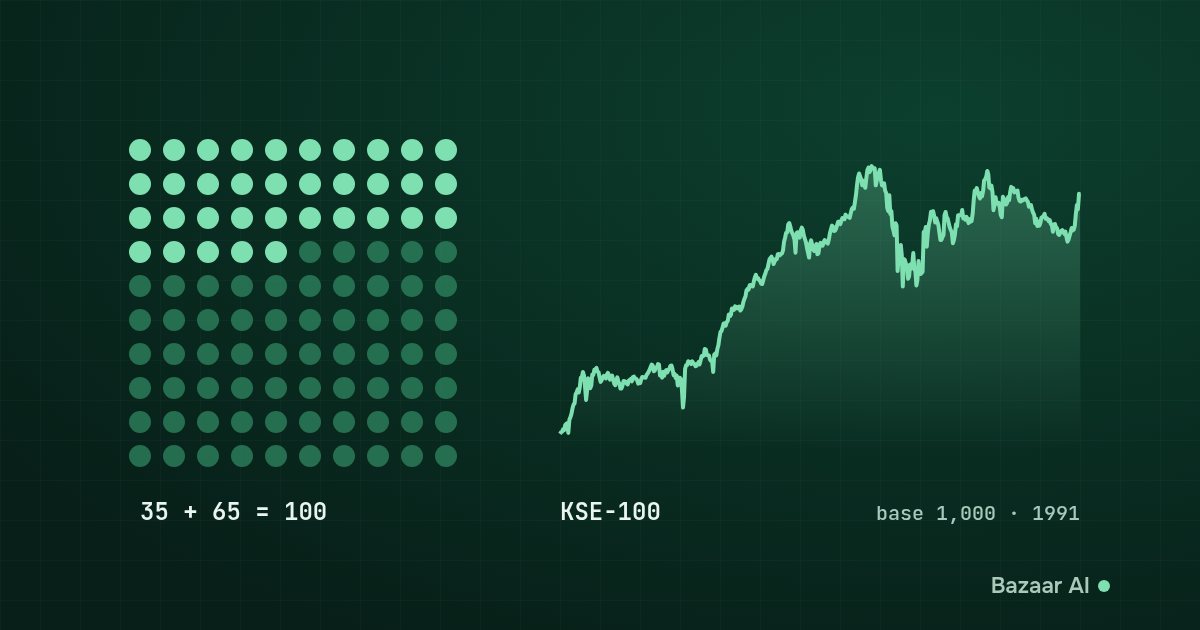
The KSE-100 was introduced in November 1991, and its base day is 1 November 1991. The PSX took the total value of the companies in the index on that day and called it 1,000 points. Every reading since then is the same basket's value compared with that starting point.
So 180,727 does not mean rupees or shares. It means the basket is worth roughly 180 times what it was worth on the base day, on the index's own terms.
Rule one: it is not just the hundred biggest companies
The PSX picks the hundred in two steps.
First, it takes the largest company in each of the exchange's sectors. The methodology lists 36 sectors, and open-end mutual funds are left out, so that is 35 companies: one cement company, one fertiliser company, one sugar company, one leasing company, and so on, whatever their size.
Then the remaining 65 places go to the largest companies left, in order of size.
The result is an index that deliberately represents the whole economy rather than just its heavyweights. A sector leader can be in the KSE-100 while a bigger company in a crowded sector is not. That is a design choice, and it is why the PSX says the index captures around 80% of the market's tradable value rather than all of it.
Companies on the Defaulters' Counter, or whose trading was suspended at any point in the six months before a review, are not eligible.
Rule two: it only counts the shares that can actually trade
"Size" here does not mean every share a company has issued. Since 15 October 2012 the KSE-100 has used free float: the shares that are realistically available to buy and sell.
The PSX takes a company's total shares and removes those held by directors, sponsors and controlling shareholders, government holdings as promoter, shares held by group companies in each other, and physical shares still held outside the depository. What remains is the free float.
Each company is then put into a band, rounded up to the next 5%. A company with 23% of its shares in free float is counted at 25%; one with 61% is counted at 65%.
This matters more than it sounds. A company whose sponsors own 80% of it may be enormous on paper, but only the 20% the market can trade moves the index. Before 2012, a tightly held giant could swing the KSE-100 on very little trading. Free float puts the weight where the trading is.
Rule three: it includes the dividends
This is the rule behind the two numbers at the top. The PSX's own description is direct: the KSE-100 is a total return index, meaning dividends, bonus shares and rights issues are adjusted into it.
When a company pays a dividend its share price usually drops by roughly that amount, because the cash has left the company and gone to shareholders. A plain price index would record that as a loss. The KSE-100 does not, because the dividend was a return to the investor, not a fall in value.
The KSE-100 PR is the price-only version of the same basket. The PSX launched it on 30 June 2025 and calculated it back to a starting value of 6,931 points on 1 April 2009, so it shows what the hundred companies' prices alone have done since then: about 7.7 times higher by 10 November 2026. The KSE-100 has risen faster over the same years, and the difference is the dividends, counted as if they had been reinvested.
Two practical consequences follow.
- When you compare a share you own against the KSE-100, include the dividends you received, or the comparison is unfair to your share.
- When you compare the PSX with a market whose headline index is price-only, the KSE-100 will look better than a like-for-like comparison would.
How the calculation works
Underneath, the arithmetic is simple. For each company, multiply its current share price by its free-float shares. Add the hundred results together. Divide by a number called the divisor, which was set so that the base day equals 1,000.
The PSX's own example uses three companies. If together they are worth Rs 10 billion on the base day, that is 1,000 points. If they are later worth Rs 11 billion, the index is at 1,100.
The divisor is the part people never see. When a company is swapped in or out, or pays a dividend, the PSX adjusts the divisor after the close, so that the change in the basket does not show up as a jump in the index. Only price changes move the number during the day.
How the hundred change
The basket is reviewed twice a year, and the rules are written to stop it churning on a single good month.
- A company that becomes the largest in its sector enters after holding that position for two consecutive reviews, or after one review if it is at least 10% bigger than the current sector leader.
- A company competing on size enters if it stays larger than the smallest size-based member for two reviews, and that member leaves.
- A newly listed company can join after one review if its free float is worth at least 2% of the whole index.
Why the index and your shares disagree
Put the three rules together and a common frustration explains itself. The KSE-100 is weighted by free-float value, so a handful of large, widely traded companies carry a big share of every move. On a day when they rise, the index can close green while most companies, and possibly most of yours, close red.
The index is a measure of the market's value. It is not a measure of the typical share. When the two diverge, the number of shares rising against those falling tells you more about what kind of day it really was.
Index levels are PSX closing values for 10 November 2026. The rules described are from the PSX's published KSE-100 methodology, and the KSE-100 PR's start date and base value from the PSX's notice launching it.