Opening a PSX account, step by step
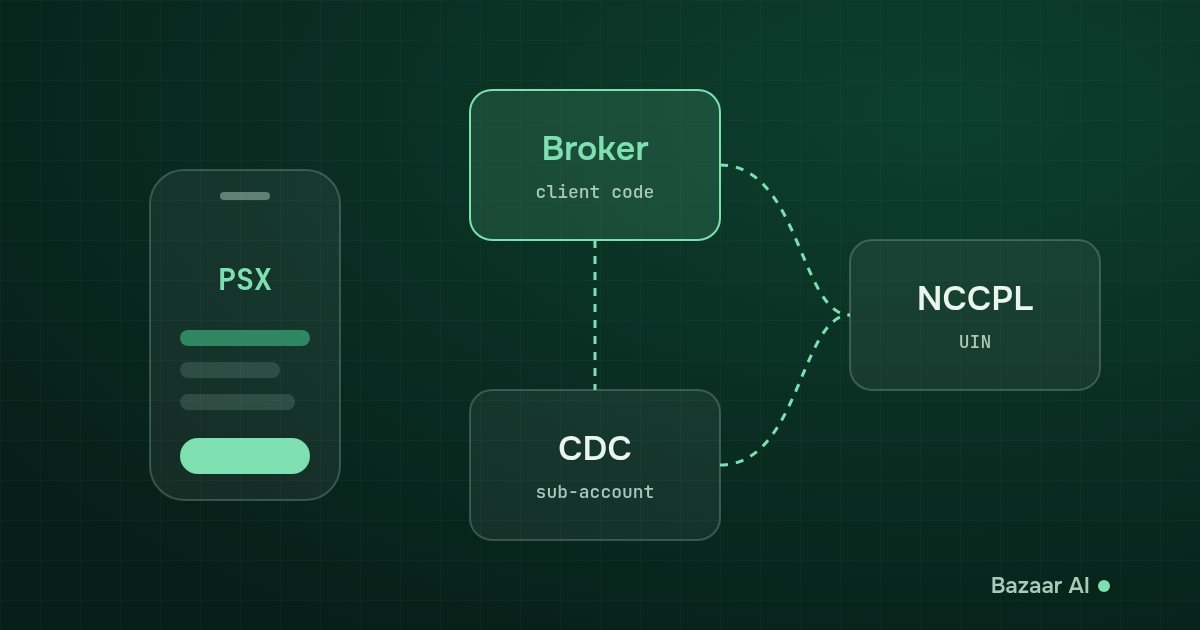
The first surprise for most people is that there is no such thing as an account "at the PSX". The exchange is where trades are matched. You reach it through a broker, and what you call "my PSX account" is really three accounts that work together.
Knowing which is which is worth ten minutes, because it tells you where your shares are held, where your cash is, and who can move either.
Step 1: choose a licensed broker
Only a broker that holds a Trading Right Entitlement Certificate (a "TREC holder") from the PSX and a licence from the Securities and Exchange Commission of Pakistan (SECP) can place orders for you. The PSX website publishes the list of active TREC holders, their registered branches, the brokers that open accounts online, and the brokers that run Shariah-compliant accounts.
Check the name there before you sign anything. A person who offers to "invest for you" through a firm that is not on that list is not a broker.
When comparing the brokers that are, the useful questions are practical ones: their commission rate, whether they have a trading app you are comfortable with, how they send trade confirmations, and whether they have a branch near you if you ever need one.
Step 2: fill in the account opening form
Brokers use a Standardised Account Opening Form (SAOF), and the PSX publishes the standard version so you can compare it with what your broker hands you. For an individual, the main document is your CNIC; joint holders and nominees need theirs too, and a non-resident adds a passport copy. Many brokers now let you do all of this online.
The broker is required to check who you are and where your money comes from before the account opens. That is why you may be asked about your occupation and income. It is the law on every licensed broker, not a sign that something is wrong.
Read the form before you sign it. The PSX's own advice is to strike out any clause that does not apply to you and have the broker countersign the change.
Step 3: understand the three accounts you now have
Opening the form sets up three things at once.
The brokerage account. This is your account with the broker. It has a client code, and it is where your cash sits before you buy and after you sell.
The CDC sub-account. Shares on the PSX exist only in electronic form, held by the Central Depository Company (CDC). A sub-account is the slot under your broker's main CDC account that holds your shares. When you buy, shares arrive here; when you sell, they leave from here.
The UIN. The National Clearing Company of Pakistan (NCCPL) gives every investor a Unique Identification Number. Every trade you make is recorded against it, across every broker you use, which is how the system knows a trade is yours.
There is a fourth account the PSX encourages but does not require: a CDC Investor Account, held with the CDC directly rather than under your broker. The PSX describes it as more secure, because shares in it move only when you give the instruction. Investors who plan to hold for years often keep their long-term shares there and only move what they want to sell.
Step 4: put money in, from your own bank account
You fund the account from a bank account in your own name, by cheque or bank transfer. The PSX is explicit that this is not a cash deposit. A broker who asks for cash in hand, or for a transfer to a personal account, is breaking the rules that protect you.
Before you trade, ask for the full list of what each trade costs: the broker's commission, the CDC and clearing charges, and the taxes. Capital gains tax depends on whether you are on the active taxpayer list, so check your own status. The rates are set in the federal budget and change, so your broker's current schedule is the figure to rely on.
Step 5: place an order, and check every confirmation
You can place orders by phone or through the broker's app. After each executed trade the broker must send you a confirmation, and you are entitled to periodic statements of your cash and shares.
Read them. The PSX's advice is to compare every confirmation with what you asked for and to raise any difference with the broker straight away. You can also check your shares against CDC's own records, which is the independent view of what you hold.
Settlement now happens one business day after the trade. We explained what that changed in T+1, and what actually changed in February.
If you are starting small: the Sahulat account
The PSX also offers a simplified Sahulat Account for individuals assessed as low-risk. It needs only a CNIC and no proof of income, which suits students, homemakers and anyone without a salary slip. In exchange it has a ceiling on how much you can invest, reported at Rs 800,000 since the facility was launched. Confirm the current limit with the broker before you rely on it.
If you live abroad: Roshan Digital Account
Overseas Pakistanis can invest in the PSX through a Roshan Digital Account with a Pakistani bank, using the Roshan Equity Investment route. You pick a broker that takes part in it, and the bank and the broker open the trading account between them, so nothing has to be done in person in Pakistan.
Three things to avoid
- Discretionary accounts. These let the broker trade without asking you first. The PSX advises against them.
- Promised returns. Nobody licensed to sell you shares can promise what they will be worth. A guarantee is a warning sign.
- Sharing your login or PIN. Your app login and your CDC access are yours alone, including with the broker's staff.
Practise before you put money in
If you would like to see how orders, fills and costs work before your real account is open, the virtual trading desk on Bazaar AI (free to sign up) runs on live PSX prices with simulated money. It places no real orders, and it charges the same kind of commission a broker would, so the numbers feel real.
This article explains how the account system works. It is not advice on which broker to choose or what to buy.