Bonus shares and right issues, and what actually changes for you
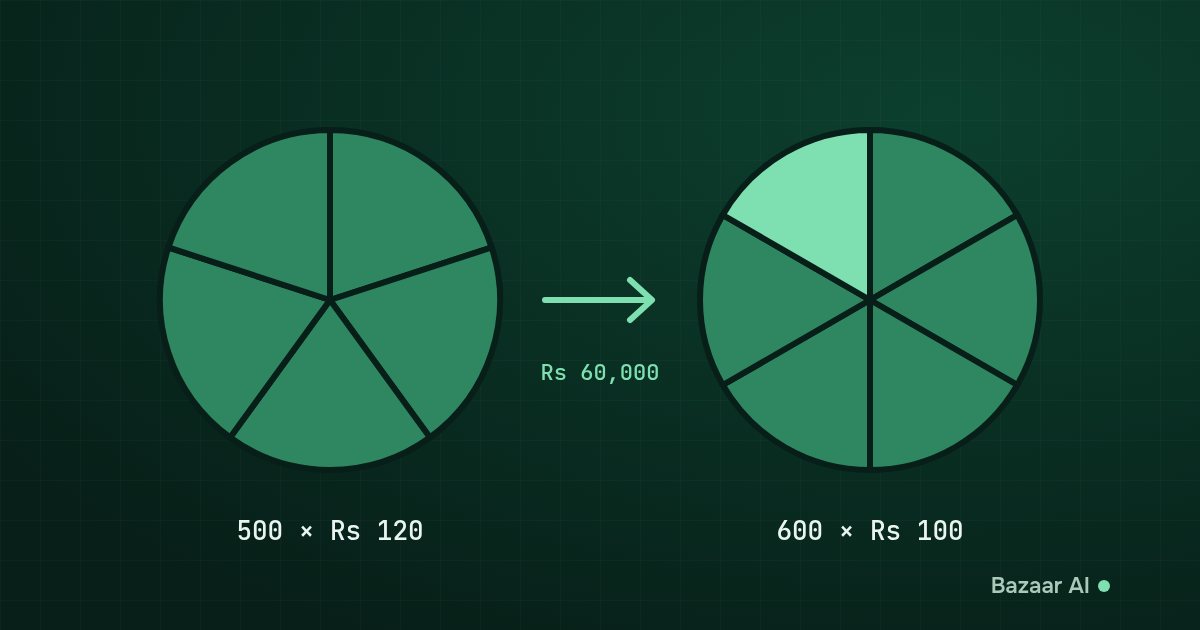
Two kinds of announcement confuse new investors more than any other: "20% bonus" and "25% right issue". Both add shares to your account. They are opposites in almost every other way.
A bonus issue is free and changes nothing about the value of what you own. A right issue asks you to pay, and ignoring it can quietly cost you money. Here is the arithmetic of both, with round numbers.
Bonus shares: more slices, same cake
A bonus issue gives existing shareholders new shares at no cost, paid for out of the company's reserves rather than in cash. A 20% bonus means one new share for every five you hold.
Nothing leaves the company and nothing comes in. The company is worth the same the day after as the day before; it is simply divided into more shares. So the share price adjusts down to match.
Say you hold 500 shares at Rs 120. That is Rs 60,000.
After a 20% bonus you hold 600 shares. If the company's value is unchanged, the price adjusts to Rs 120 ÷ 1.2 = Rs 100. And 600 × Rs 100 is still Rs 60,000.
The adjustment happens on the ex-date, when the shares start trading without the right to the bonus. That is why a stock can appear to "fall 17%" on a day when nothing happened: the price data has not been adjusted, and the shareholder has lost nothing.
Why companies issue them anyway
If a bonus changes nothing, why bother? A few reasons come up often.
- Keeping cash. A company that wants to reward shareholders but keep its cash for the business can issue shares instead of paying a dividend.
- A lower price per share. More shares at a lower price can make the stock easier to trade in small amounts.
- A signal. Boards tend to issue bonuses when they expect profits to cover the larger share count, and the market sometimes reads it that way.
One practical effect lasts: future dividends are paid per share, so a company that keeps its dividend per share the same after a bonus is paying out more in total.
Fractions. If your holding does not divide evenly, you cannot receive part of a share. The announcement says how the company handles fractions; the usual practice is to combine them, sell them in the market and pay the cash to the shareholders they belonged to.
Right issues: the company asks you for money
A right issue raises new money. The company offers existing shareholders new shares in proportion to what they hold, at a fixed price, usually below the market price. A 25% right at Rs 30 means you may buy one new share for every four you own, paying Rs 30 for each.
You have three choices, and each one has a different result.
Subscribe. Pay for your new shares within the subscription period. You keep your share of the company.
Sell the right. On the PSX, the right itself trades as a separate instrument for a period before subscription closes. You can sell it, and someone else pays for the shares instead.
Do nothing. The right lapses at the end of the period. This is the costly choice, and the arithmetic shows why.
The arithmetic of ignoring a right
Say you hold 100 shares at Rs 50, and the company announces a 25% right at Rs 30.
Before the issue, your shares are worth 100 × Rs 50 = Rs 5,000.
After the issue there are 125 shares for every 100 there were, and the company has taken in Rs 30 for each new one. A common way to estimate where the price should settle, called the theoretical ex-right price, is:
(100 × Rs 50 + 25 × Rs 30) ÷ 125 = Rs 5,750 ÷ 125 = Rs 46
If you do nothing, your 100 shares are now worth 100 × Rs 46 = Rs 4,600. You have lost Rs 400 of value, and the company has not done anything wrong. The value went to whoever subscribed at Rs 30 for shares worth Rs 46.
Each right was worth about Rs 46 − Rs 30 = Rs 16. Your 25 rights were worth about Rs 400: exactly what you lost by letting them lapse. Selling them would have recovered it. Subscribing would have kept it in your shares.
Real prices rarely land exactly on the formula, but the direction is reliable.
Why a company asks
The announcement says what the money is for. Expansion, a new plant or an acquisition is one kind of reason. Repaying debt or rebuilding capital after losses, or meeting a regulator's capital requirement, is another. The same "right issue" headline can mean a company growing or a company repairing itself, and the stated purpose is the place to find out which.
Right issues are often underwritten: if shareholders do not take up all the shares, the underwriters buy what is left, so the company gets its money either way.
Which dates matter
Both kinds of issue are given to whoever holds the shares before the book closure begins, and the announcement gives the dates. Shares bought on or after the ex-date come without the bonus or the right.
For a right issue there are two more dates to note: when the rights trade on the PSX, and the last day to pay for your new shares. Missing the second is the same as doing nothing.
This article explains how bonus and right issues work. It is not advice on any particular issue.