How to read a result announcement on the PSX
Every listed company in Pakistan has to publish its numbers on a fixed clock. The law gives a listed company 30 days after the end of its first and third quarters to send out its quarterly accounts, and 60 days after the second. The audited annual accounts must be in front of shareholders at the annual general meeting within 120 days of the year end.
Most PSX companies close their year on 30 June, so the quarter that ended on 30 September is their first quarter, and those results land through October and early November. Banks close their year in December, so for them the same quarter is the third. Several sugar companies close in September. The quarter's label matters, because "first quarter" and "nine months" are very different amounts of time.
The announcement appears on the PSX's company announcements page as "Financial Results for the Quarter Ended...", usually on the day of the board meeting that approved them. Here is how to read it in five minutes.
First, check which statement you are reading
Many announcements carry two sets of numbers. Unconsolidated results are the company on its own. Consolidated results add its subsidiaries. For a company with large subsidiaries the two can tell different stories.
Neither is wrong. Pick one and compare like with like: this year's consolidated with last year's consolidated.
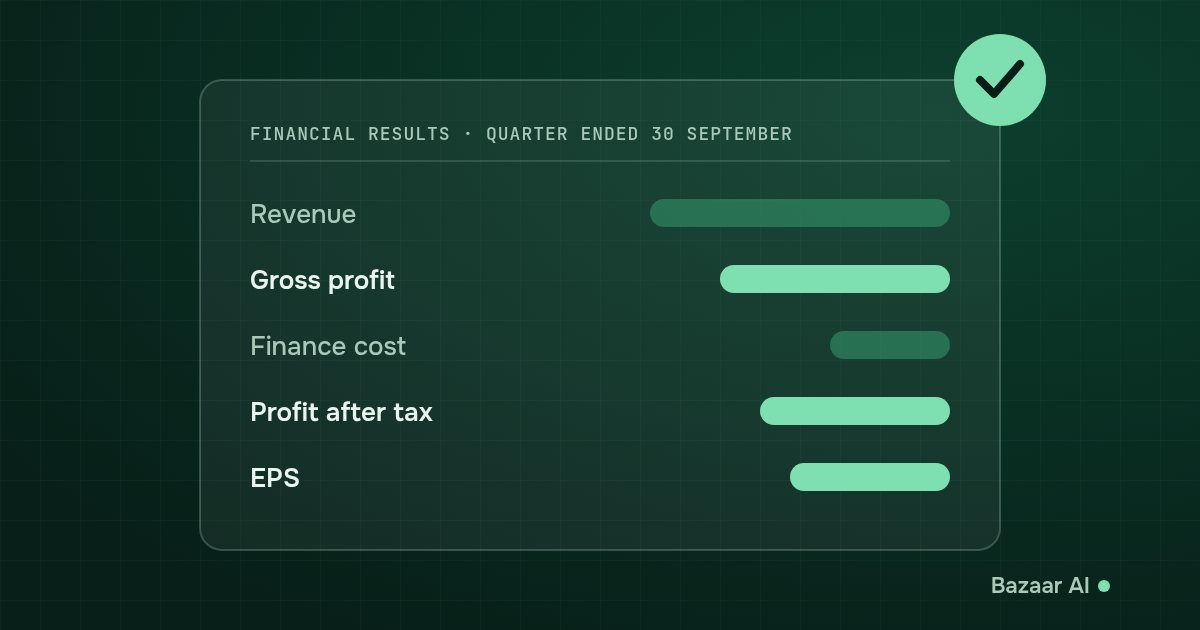
The five lines that matter
Revenue (sales). What the company sold. On its own it tells you little; compared with the same period last year it tells you whether the business grew.
Gross profit. Revenue minus the direct cost of what was sold. Divide it by revenue to get the gross margin. A company whose sales grew 20% while its margin fell from 25% to 18% has a pricing or cost problem that the headline growth hides.
Finance cost. The interest the company paid. In Pakistan this line moves with the policy rate and with how much the company has borrowed, and for indebted companies it can swing profit more than anything that happened in the business.
Profit after tax. What is left for shareholders. Check the taxation line just above it: a change in tax, such as super tax, can move this number without any change in how the business performed.
Earnings per share (EPS). Profit after tax divided by the number of shares. It is the figure most coverage quotes, and the one to compare across periods, because it already adjusts for the number of shares in issue.
Compare with the right period
Compare a quarter with the same quarter last year, not with the quarter just before it. Fertiliser, cement, textiles and many other sectors are seasonal, and a fall from the previous quarter may be nothing more than the calendar.
For the later quarters, the announcement also shows the cumulative figure: six months, or nine. That smooths out a single unusual quarter and is often the better guide to the year.
If EPS for last year is marked "restated", the company has adjusted it, usually because it issued bonus shares. The restated figure is the one to compare with, because it divides last year's profit by today's number of shares.
Look for the payout
The last part of the announcement says whether the board has declared anything for shareholders, and it is often the part the market reacts to first.
- A cash dividend, written as a percentage. It is a percentage of the share's face value, not of its market price, which we explained in What a 150% dividend actually pays you.
- Bonus shares, also as a percentage: a 10% bonus means one new share for every ten you hold.
- The book closure dates, which decide who is entitled. You have to own the shares before the book closure begins.
"Nil" or no payout line at all is common in a quarter, and is not itself bad news. Many companies pay only with annual results.
Watch for one-off items
Profit can jump or fall for reasons that will not repeat: a gain on selling land, an exchange gain or loss on foreign currency loans, a one-time tax charge, or an impairment. These usually sit in "other income", "other expenses" or the tax line, and the notes to the accounts explain them.
A result that beats last year only because of other income is a different result from one that beats it on sales and margin.
Why the price may move the "wrong" way
By the time the announcement arrives, analysts have published their estimates and the price already reflects what the market expected. A company can report record profit and fall, because the record was smaller than expected, or report a loss and rise, because it was smaller than feared.
The useful question is not "was it good?" but "was it better or worse than what the market was expecting, and why?"
A five-minute checklist
- Unconsolidated or consolidated, and the same one as last year.
- Revenue and gross margin against the same period last year.
- Finance cost and tax: did either move profit on its own?
- EPS, using last year's restated figure if there is one.
- The payout and its book closure dates.
You can also ask Bazaar AI about a company's latest result in plain words. It reads the filing, answers with the figures, and links each one to the page of the company's own PDF it came from, so you can check it yourself.
This article explains how to read a financial statement. It is not a view on any company or advice to buy or sell.